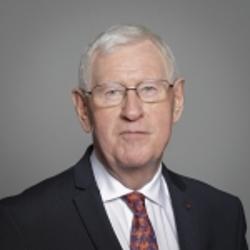
Lord Touhig
Labour - Life peer
Joined House of Lords: 28th June 2010
Don Touhig was elected as an MP between 1995 and 2010. He served as Parliamentary Under-Secretary (Wales Office) between 2001 and 2005 and as Parliamentary Under-Secretary (Ministry of Defence) (Veterans) between 2005 and 2006.
3 APPG Officer Positions (as of 29 Jun 2026)
Autism, France, Netherlands4 APPG Memberships
Italy, Adoption and Permanence, Christians in Parliament, Mutuals4 Former APPG Officer Positions
Armed Forces Covenant, Belgium, Italy, LuxembourgDivision Voting information
Debates during the 2024 Parliament
Speeches made during Parliamentary debates are recorded in Hansard. For ease of browsing we have grouped debates into individual, departmental and legislative categories.
Sparring Partners
Minister of State (Department for Work and Pensions)
(8 debate interactions)
Minister of State (Department for Work and Pensions)
(6 debate interactions)
(4 debate interactions)
Department Debates
(14 debate contributions)
(2 debate contributions)
(2 debate contributions)
(2 debate contributions)
Lords initiatives
These initiatives were driven by Lord Touhig, and are more likely to reflect personal policy preferences.
Lord Touhig has not introduced any legislation before Parliament
Lord Touhig has not co-sponsored any Bills in the current parliamentary sitting
Latest 30 Written Questions
(View all written questions)The early identification of special educational needs and disabilities is critical to improving outcomes for children and young people.
Our consultation proposed that we will introduce clear statutory duties on schools to identify and meet needs as early as possible, enabling timely and effective intervention for pupils with special educational needs (SEN).
To support delivery, we are strengthening the evidence base on what works in early identification and assessment across education settings.
We will also introduce National Inclusion Standards, equipping educators with evidence informed tools and strategies to identify, assess and support pupils with SEN, while sharing best practice nationally. This is backed by £1.8 billion of investment to expand capacity and expertise, ensuring every community can access Experts at Hand.
In parallel, government backed research led by UK Research and Innovation will develop and scale new approaches to early identification, strengths‑and‑needs assessment, and support, for integration into education settings by 2028.
Minister of State (Department for Work and Pensions)
The government will develop a national cost framework for specialist provision packages, and we expect local authorities to commission provision based on that framework, whether that is within a specialist base in a mainstream school, or a special school, including those in the independent sector.
We will undertake a period of evidence gathering and stakeholder engagement to ensure that the framework is appropriately supporting high quality provision whilst tackling excessive prices and profit making.
Minister of State (Department for Work and Pensions)
Many local authorities have systems which indicate the range of top-up funding that might be provided for children and young people with a particular type and complexity of need, sometimes referred to as ‘banding frameworks’. These can help determine levels of high needs top-up funding for children and young people with special educational needs and disabilities. A system which agrees likely levels of top-up funding in advance can also be an efficient, clear and transparent way of allocating funding.
The department has published guidance on how local authorities should allocate this funding. Section 7.4 of the high needs funding operational guidance sets out that top-up funding can reflect the costs of provision for a cohort of pupils at or within a school or college. The operational guidance is available on GOV.UK.
Funding does not need to be tied to the detailed provision that may be required or which is specified in education, health and care (EHC) plans, since schools and colleges have flexibility in deploying resources.
The local authority must be satisfied, however, that the final allocation of funding (both the top-up funding and other elements of funding) is sufficient to secure suitable provision for example, as outlined in an EHC plan.
Minister of State (Department for Work and Pensions)
The department recognises that families play a vital role in identifying and understanding their children’s needs, and we expect education settings to work in partnership with parents and carers as part of early identification, ongoing assessment and the timely provision of support.
We will place a duty on settings to produce an Individual Support Plan (ISP) for any child or young person with special educational needs and disabilities (SEND). The ISP will be developed by settings together with parents and young people, giving every child or young person with SEND a clear and consistent record of their needs and the help they receive, so that support is joined‑up, timely and genuinely centred on what will help them to thrive. ISPs will be used to communicate provision to parents and actions taken between parents and settings, supporting the relationship between home and setting. ISPs must be reviewed at least annually and may be reviewed more frequently as a child’s needs develop.
Minister of State (Department for Work and Pensions)
Individual Support Plans (ISPs) will provide a record of need and provision for any child or young person receiving targeted, targeted plus or specialist support in school or college. They will allow settings to work alongside parents, providing a single, consistent record of what support has been tried, what has worked and what needs to change.
Under the proposals, settings will have a legal duty to produce an ISP for every child with special educational needs and disabilities (SEND), including those who also have an education health and care plan. Where there are concerns about provision within an ISP, parents and young people would be able to raise these directly with the setting. The department’s proposals include strengthening the complaints process through having an independent SEND expert on panels to hear complaints concerning provision for a child with SEND.
Minister of State (Department for Work and Pensions)
The information requested is shown in the below table. The footnotes for the missing data table should be reviewed as they explain some of the limitations to this data.
Data on looked after unaccompanied asylum-seeking children (UASC) in England is published in the annual statistical release ‘Children looked after in England including adoptions’. The latest data is for year ending 31 March 2025 and has been available since 20 November 2025.
In these statistics, ‘missing’ is defined as a looked after child who is not at their placement or a place they are expected to be and their whereabouts is not known. A child may have had multiple missing incidents during a year that may have been resolved only to conclude with a further incident that results in the child being missing again on 31 March. Any missing incident is concerning but the vast majority (91%) of incidents, where a child who is looked after and reportedly goes missing, last for two days or less.
The department holds responsibility for the collection and publication of statistics for children looked after by local authorities in England only. Similar statistics for other countries in the UK are the responsibility of the devolved administrations.
Children missing on 31 March who were unaccompanied asylum-seeking children (UASC), 2021 to 2025, England
| 2021 | 2022 | 2023 | 2024 | 2025 |
Children looked after on 31 March who were UASC | 4,150 | 5,680 | 7,410 | 7,440 | 6,540 |
Number of UASC who went missing during | 1,000 | 1,160 | 1,490 | 1,700 | 1,620 |
Number of UASC who were missing on 31 March | 80 | 80 | 60 | 70 | 40 |
Footnotes
1. Numbers have been rounded to the nearest 10. Figures exclude children looked after under a series of short-term placements.
2. Historical data may differ from older publications which is mainly due to amendments made by local authorities after the previous publication. However, users looking for a longer time series may wish to check for the equivalent table in earlier releases.
3. Missing is defined as a looked after child who is not at their placement or a place they are expected to be and their whereabouts is not known.
4. Since 2017 a growing number of local authorities informed the department that they do not record incidents as 'away without authorisation', but instead report all incidents as 'missing' to maintain consistency with local police reporting. We estimate this could mean an overestimate of missing incidents of up to 13% in 2021, 10% in 2022, 11% in 2023, 13% in 2024 and 12% in 2025; suggesting the true figures could be more like 9,600, 11,100, 11,500, 11,500 and 11,300. There is a corresponding estimate of an undercount of away without authorisation incidents of up to 32% in 2021, 30% in 2022, 32% in 2023, 36% in 2024 and 32% in 2025; suggesting the true figures could be more like 3,800, 3,600, 3,900, 4,300 and 4,300. However some of these local authorities submitted some 'away without authorisation' information and this can be found in the away from placement without authorisation table.
5. Figures for 2021 exclude data for Hackney.
Minister of State (Department for Work and Pensions)
The information requested is shown in the below table. The footnotes for the missing data table should be reviewed as they explain some of the limitations to this data.
Data on looked after unaccompanied asylum-seeking children (UASC) in England is published in the annual statistical release ‘Children looked after in England including adoptions’. The latest data is for year ending 31 March 2025 and has been available since 20 November 2025.
In these statistics, ‘missing’ is defined as a looked after child who is not at their placement or a place they are expected to be and their whereabouts is not known. A child may have had multiple missing incidents during a year that may have been resolved only to conclude with a further incident that results in the child being missing again on 31 March. Any missing incident is concerning but the vast majority (91%) of incidents, where a child who is looked after and reportedly goes missing, last for two days or less.
The department holds responsibility for the collection and publication of statistics for children looked after by local authorities in England only. Similar statistics for other countries in the UK are the responsibility of the devolved administrations.
Children missing on 31 March who were unaccompanied asylum-seeking children (UASC), 2021 to 2025, England
| 2021 | 2022 | 2023 | 2024 | 2025 |
Children looked after on 31 March who were UASC | 4,150 | 5,680 | 7,410 | 7,440 | 6,540 |
Number of UASC who went missing during | 1,000 | 1,160 | 1,490 | 1,700 | 1,620 |
Number of UASC who were missing on 31 March | 80 | 80 | 60 | 70 | 40 |
Footnotes
1. Numbers have been rounded to the nearest 10. Figures exclude children looked after under a series of short-term placements.
2. Historical data may differ from older publications which is mainly due to amendments made by local authorities after the previous publication. However, users looking for a longer time series may wish to check for the equivalent table in earlier releases.
3. Missing is defined as a looked after child who is not at their placement or a place they are expected to be and their whereabouts is not known.
4. Since 2017 a growing number of local authorities informed the department that they do not record incidents as 'away without authorisation', but instead report all incidents as 'missing' to maintain consistency with local police reporting. We estimate this could mean an overestimate of missing incidents of up to 13% in 2021, 10% in 2022, 11% in 2023, 13% in 2024 and 12% in 2025; suggesting the true figures could be more like 9,600, 11,100, 11,500, 11,500 and 11,300. There is a corresponding estimate of an undercount of away without authorisation incidents of up to 32% in 2021, 30% in 2022, 32% in 2023, 36% in 2024 and 32% in 2025; suggesting the true figures could be more like 3,800, 3,600, 3,900, 4,300 and 4,300. However some of these local authorities submitted some 'away without authorisation' information and this can be found in the away from placement without authorisation table.
5. Figures for 2021 exclude data for Hackney.
Minister of State (Department for Work and Pensions)
The information requested is shown in the below table. The footnotes for the missing data table should be reviewed as they explain some of the limitations to this data.
Data on looked after unaccompanied asylum-seeking children (UASC) in England is published in the annual statistical release ‘Children looked after in England including adoptions’. The latest data is for year ending 31 March 2025 and has been available since 20 November 2025.
In these statistics, ‘missing’ is defined as a looked after child who is not at their placement or a place they are expected to be and their whereabouts is not known. A child may have had multiple missing incidents during a year that may have been resolved only to conclude with a further incident that results in the child being missing again on 31 March. Any missing incident is concerning but the vast majority (91%) of incidents, where a child who is looked after and reportedly goes missing, last for two days or less.
The department holds responsibility for the collection and publication of statistics for children looked after by local authorities in England only. Similar statistics for other countries in the UK are the responsibility of the devolved administrations.
Children missing on 31 March who were unaccompanied asylum-seeking children (UASC), 2021 to 2025, England
| 2021 | 2022 | 2023 | 2024 | 2025 |
Children looked after on 31 March who were UASC | 4,150 | 5,680 | 7,410 | 7,440 | 6,540 |
Number of UASC who went missing during | 1,000 | 1,160 | 1,490 | 1,700 | 1,620 |
Number of UASC who were missing on 31 March | 80 | 80 | 60 | 70 | 40 |
Footnotes
1. Numbers have been rounded to the nearest 10. Figures exclude children looked after under a series of short-term placements.
2. Historical data may differ from older publications which is mainly due to amendments made by local authorities after the previous publication. However, users looking for a longer time series may wish to check for the equivalent table in earlier releases.
3. Missing is defined as a looked after child who is not at their placement or a place they are expected to be and their whereabouts is not known.
4. Since 2017 a growing number of local authorities informed the department that they do not record incidents as 'away without authorisation', but instead report all incidents as 'missing' to maintain consistency with local police reporting. We estimate this could mean an overestimate of missing incidents of up to 13% in 2021, 10% in 2022, 11% in 2023, 13% in 2024 and 12% in 2025; suggesting the true figures could be more like 9,600, 11,100, 11,500, 11,500 and 11,300. There is a corresponding estimate of an undercount of away without authorisation incidents of up to 32% in 2021, 30% in 2022, 32% in 2023, 36% in 2024 and 32% in 2025; suggesting the true figures could be more like 3,800, 3,600, 3,900, 4,300 and 4,300. However some of these local authorities submitted some 'away without authorisation' information and this can be found in the away from placement without authorisation table.
5. Figures for 2021 exclude data for Hackney.
Minister of State (Department for Work and Pensions)
The government is committed to upholding the principles of the UN Convention of the Rights of the Child and safeguarding the rights of children, as we continue to do through the Children’s Wellbeing and Schools Bill.
We know that some schools choose to follow the UNICEF scheme ‘Rights Respecting Schools Award’, which puts children’s rights at the heart of school policy and practice, and we welcome that commitment to promoting the rights of children. However, there are no plans to provide funding for the ‘Rights Respecting Schools Award’ scheme in England.
All schools in England have specific duties to promote the spiritual, moral, social and cultural (SMSC) development of their pupils and prepare them for the opportunities and responsibilities of adult life.
Schools in England are required to promote the fundamental British values of democracy, rule of law, individual liberty and mutual respect and tolerance of those of different faiths and beliefs. Citizenship education is an effective way of doing this, and we expect teachers to reinforce these values as well as to support pupils’ SMSC development.
Ministers welcome the opportunity to meet children and would be grateful for requests to be sent to the office of my hon. Friend, the Minister for School Standards.
Minister of State (Department for Work and Pensions)
Education plays a vital role in promoting integration and ensuring children and young people are prepared for life, including learning about the values that underpin and unite our society. All schools in England have a duty to promote the spiritual, moral, social and cultural development of their pupils and to prepare them for the opportunities and responsibilities of adult life. It is up to schools to decide whether to join UNICEF’s Rights Respecting School programme.
Citizenship education provides a framework for pupils to develop the knowledge, skills and values that will prepare them to take their place in society as responsible citizens. Citizenship forms a core part of the statutory national curriculum at key stages 3 and 4 and primary schools can choose to teach citizenship at key stages 1 and 2, following the non-statutory framework for citizenship.
Minister of State (Department for Work and Pensions)
This government’s ambition is that all children and young people with special educational needs and disabilities (SEND) receive the right support to succeed in their education and as they move into adult life.
The department is committed to improving inclusivity and expertise in mainstream schools and colleges, as well as ensuring special settings cater to those with the most complex needs, restoring parents’ trust that their child will get the support they need. This includes strengthening accountability for inclusivity, including through Ofsted, and encouraging schools to set up resourced provision or special educational needs (SEN) units to increase capacity in mainstream schools.
High-quality teaching is central to ensuring that all pupils, including those with Down’s Syndrome or other types of SEND, are given the best possible opportunity to achieve. The department is committed to recruiting an additional 6,500 new expert teachers over the course of this parliament. To support all teachers, the department is also implementing a range of teacher training reforms to ensure teachers have the skills to support all pupils to succeed, including those with SEND.
On 1 September 2024, the government introduced a new mandatory leadership level qualification for special educational needs coordinators (SENCOs) in mainstream schools. The qualification will play a key role in improving outcomes for pupils with SEND, including Down’s Syndrome, by ensuring SENCOs consistently receive high-quality, evidence-based training on how best to support children with SEND.
High needs funding will also increase by almost £1 billion in 2025/26, compared to 2024/25. The department has also announced £740 million of capital funding to create more specialist places including in mainstream schools.
Minister of State (Department for Work and Pensions)
The department works with the Education Endowment Foundation (EEF) to support building the evidence base for early language interventions. In July 2024, the department announced that funded support for the 11,100 schools registered for the Nuffield Early Language Intervention (NELI) programme (two thirds of English state primary schools) would continue for the 2024/25 academic year. NELI is the most robustly evidenced early language programme in the UK, helping children who need extra support with their speech and language development to make four months of additional progress and seven months for those on free school meals.
To support early language skills, the department has invested over £20 million in NELI. The department does not hold the exact number of children who have completed NELI since 2020, but an estimate is based on the data included in EEF’s 'NELI Scale-up: Evaluation Report - Year 2', as attached. The programme has screened more than 650,000 children in the last four years and supported more than 210,000 four and five-year-olds since the pandemic. Broken down by academic year, this is:
2020/21: 35,000
2021/22: 59,000
2022/23: 58,000
2023/24: 59,000
The Stronger Practice Hubs, which provide advice, share good practice and offer evidence-based professional development for early years practitioners, have also collaborated with the EEF to fund and make places available on several early language programmes. This is helping to strengthen and add to the evidence base of early years professional development programmes. The department does not hold data on the number of children who have benefitted from these programmes.
The number of new schools who registered to deliver NELI in each academic year since 2020 are as follows:
2020/21: 6,668
2021/22: 4,418
2022/23: 26
2023/24: no new school registration undertaken
For registered schools, the government has continued to fund the intervention so that schools can deliver the programme to new cohorts of reception children, where they are identified with below or well-below average language levels. We do not hold figures on how many of these schools completed the full work programme in each of those years.
Minister of State (Department for Work and Pensions)
The department works with the Education Endowment Foundation (EEF) to support building the evidence base for early language interventions. In July 2024, the department announced that funded support for the 11,100 schools registered for the Nuffield Early Language Intervention (NELI) programme (two thirds of English state primary schools) would continue for the 2024/25 academic year. NELI is the most robustly evidenced early language programme in the UK, helping children who need extra support with their speech and language development to make four months of additional progress and seven months for those on free school meals.
To support early language skills, the department has invested over £20 million in NELI. The department does not hold the exact number of children who have completed NELI since 2020, but an estimate is based on the data included in EEF’s 'NELI Scale-up: Evaluation Report - Year 2', as attached. The programme has screened more than 650,000 children in the last four years and supported more than 210,000 four and five-year-olds since the pandemic. Broken down by academic year, this is:
2020/21: 35,000
2021/22: 59,000
2022/23: 58,000
2023/24: 59,000
The Stronger Practice Hubs, which provide advice, share good practice and offer evidence-based professional development for early years practitioners, have also collaborated with the EEF to fund and make places available on several early language programmes. This is helping to strengthen and add to the evidence base of early years professional development programmes. The department does not hold data on the number of children who have benefitted from these programmes.
The number of new schools who registered to deliver NELI in each academic year since 2020 are as follows:
2020/21: 6,668
2021/22: 4,418
2022/23: 26
2023/24: no new school registration undertaken
For registered schools, the government has continued to fund the intervention so that schools can deliver the programme to new cohorts of reception children, where they are identified with below or well-below average language levels. We do not hold figures on how many of these schools completed the full work programme in each of those years.
Minister of State (Department for Work and Pensions)
The department works with the Education Endowment Foundation (EEF) to support building the evidence base for early language interventions. In July 2024, the department announced that funded support for the 11,100 schools registered for the Nuffield Early Language Intervention (NELI) programme (two thirds of English state primary schools) would continue for the 2024/25 academic year. NELI is the most robustly evidenced early language programme in the UK, helping children who need extra support with their speech and language development to make four months of additional progress and seven months for those on free school meals.
To support early language skills, the department has invested over £20 million in NELI. The department does not hold the exact number of children who have completed NELI since 2020, but an estimate is based on the data included in EEF’s 'NELI Scale-up: Evaluation Report - Year 2', as attached. The programme has screened more than 650,000 children in the last four years and supported more than 210,000 four and five-year-olds since the pandemic. Broken down by academic year, this is:
2020/21: 35,000
2021/22: 59,000
2022/23: 58,000
2023/24: 59,000
The Stronger Practice Hubs, which provide advice, share good practice and offer evidence-based professional development for early years practitioners, have also collaborated with the EEF to fund and make places available on several early language programmes. This is helping to strengthen and add to the evidence base of early years professional development programmes. The department does not hold data on the number of children who have benefitted from these programmes.
The number of new schools who registered to deliver NELI in each academic year since 2020 are as follows:
2020/21: 6,668
2021/22: 4,418
2022/23: 26
2023/24: no new school registration undertaken
For registered schools, the government has continued to fund the intervention so that schools can deliver the programme to new cohorts of reception children, where they are identified with below or well-below average language levels. We do not hold figures on how many of these schools completed the full work programme in each of those years.
Minister of State (Department for Work and Pensions)
Child poverty has gone up by 700,000 since 2010, with over four million children now growing up in a low-income family. This not only harms children’s lives now, but it also damages their future prospects and holds back the economic potential of the country.
My right hon. Friend, the Prime Minister announced the appointment of my right hon. Friend, the Secretary of State for Work and Pensions and my right hon. Friend, the Secretary of State for Education to be the joint leads of a new ministerial taskforce to begin work on a child poverty strategy. The government is committed to delivering an ambitious strategy to reduce child poverty, to tackle the root causes and give every child the best start at life.
This government is committed to improving mental health support for all children and young people. This is critical to breaking down barriers to opportunity and learning. The right support should be available to every young person that needs it, which is why the government will provide access to specialist mental health professionals in every school.
The government will also be putting in place new Young Futures hubs, including access to mental health support workers, and will recruit an additional 8,500 new mental health staff to speed-up access to treatment for children and adults.
Minister of State (Department for Work and Pensions)
In the plan to Make Work Pay (October 2024), we committed to raising awareness of all forms of neurodiversity (including autism) in the workplace.
In January 2025, DWP launched an independent panel of academics with expertise and experiences of neurodiversity to advise us on boosting neurodiversity awareness and inclusion at work. This is building on the work of the Buckland Review, which was published under the previous Government, and focused more narrowly on autism employment. The evidence review concluded in late summer 2025 and the panel will be reporting their findings and recommendations shortly.
Although this Government has not made a formal response to the Buckland Review, the Ministers for Employment and Social Security and Disability met Sir Robert Buckland in October 2024 to talk about his findings and key drivers for change in the workplace. In addition, Professor Amanda Kirby, Chair of the Academic Panel, has subsequently met Sir Robert to discuss the panel's terms of reference, scope, and timelines, and in June they jointly gave evidence to this House’s Autism Act 2009 Committee.
The Government will decide next steps in the light of the panel’s recommendations, and other relevant reviews such as Sir Charlie Mayfield’s Keep Britain Working Review.
Minister of State (Department for Work and Pensions)
DWP analysis of the Office for National Statistics (ONS) Annual Population Survey (APS) shows there were an estimated 40,000 people with Autism who said they were looking for full-time employment in 2024/25.
Minister of State (Department for Work and Pensions)
Information on the number of disabled people with autism who have found work in the past 12 months is published by the Department at: The employment of disabled people - GOV.UK.
There were an estimated 90,000 people with Autism who moved into employment between 2023 and 2024 (the latest data available).
Minister of State (Department for Work and Pensions)
In the plan to Make Work Pay (October 2024), we committed to raising awareness of all forms of neurodiversity (including autism) in the workplace.
In January 2025, DWP launched an independent panel of academics with expertise and experiences of neurodiversity to advise us on boosting neurodiversity awareness and inclusion at work. This is building on the work of the Buckland Review, which was published under the previous Government, and focused more narrowly on autism employment. The evidence review concluded in late summer 2025 and the panel will be reporting their findings and recommendations shortly.
Although this Government has not made a formal response to the Buckland Review, the Ministers for Employment and Social Security and Disability met Sir Robert Buckland in October 2024 to talk about his findings and key drivers for change in the workplace. In addition, Professor Amanda Kirby, Chair of the Academic Panel, has subsequently met Sir Robert to discuss the panel's terms of reference, scope, and timelines, and in June they jointly gave evidence to this House’s Autism Act 2009 Committee.
The Government will decide next steps in the light of the panel’s recommendations, and other relevant reviews such as Sir Charlie Mayfield’s Keep Britain Working Review.
Minister of State (Department for Work and Pensions)
In our plan to Make Work Pay, we committed to raising awareness of neurodiversity in the workplace.
Our forthcoming employment White Paper considers how to improve employment outcomes and experiences for disabled people and people with health conditions. We are exploring how we can build on the earlier, independent, Buckland Review which was focused more narrowly on autism and employment, to improve understanding and support for all neurodivergent people at work.
Minister of State (Department for Work and Pensions)
It is unacceptable that many children and young people are not receiving the mental health care and support they need, and we know that waiting times for mental health services are far too long. We are determined to change that.
As part of our mission to build a National Health Service that is fit for the future and that is there when people need it, the Government will recruit 8,500 additional staff across children and adult mental health services, introduce a specialist mental health professional in every school, and roll out Young Futures hubs in every community.
Parliamentary Under-Secretary (Department of Health and Social Care)
There is no record of the Foreign, Commonwealth and Development Office having undertaken a formal study of the potential merits of membership of the Council of Europe Development Bank (CEB). The government keeps the potential membership of various international organisations under periodic review but our current position on the CEB remains as set out in our previous responses.
No such study has been commissioned under the current Government, and it would not be appropriate for me to ask officials what advice, if any, was provided under the previous administration.
To date, the UK has committed up to £577 million in humanitarian assistance to Ukraine and the wider region, including for those who have been forced to flee their homes and are now internally displaced. This funding helps deliver essential services, such as access to food, healthcare, and shelter, through trusted partners working closely with the Government of Ukraine.
The UK has not provided direct funding to the World Bank's Health Enhancement and Lifesaving Ukraine Project, but we work with the World Bank on the delivery of the SPIRIT programme (Social Protection for Inclusion, Resilience, Innovation, and Transformation) and other regional initiatives that strengthen social protection and recovery efforts.
To date, the UK has committed up to £577 million in humanitarian assistance to Ukraine and the wider region, including for those who have been forced to flee their homes and are now internally displaced. This funding helps deliver essential services, such as access to food, healthcare, and shelter, through trusted partners working closely with the Government of Ukraine.
The UK has not provided direct funding to the World Bank's Health Enhancement and Lifesaving Ukraine Project, but we work with the World Bank on the delivery of the SPIRIT programme (Social Protection for Inclusion, Resilience, Innovation, and Transformation) and other regional initiatives that strengthen social protection and recovery efforts.
The position remains as set out to the Noble Lord on 29 April 2019 in response to Question HL15270: the UK already has effective instruments to deliver development and investment objectives, including through our multilateral shareholdings such as the European Bank for Reconstruction and Development, and therefore has no plans to join the Council of Europe Development Bank.
The Home Office closed the last of the Home Office-run unaccompanied Asylum-Seeking Children hotels on 31 January 2024 and since then arriving unaccompanied Asylum-Seeking Children have been accommodated by local authorities in line with their statutory duties.
Minister of State (Home Office)