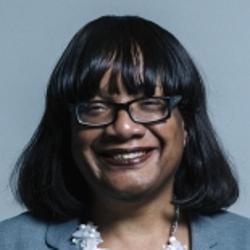
Diane Abbott
Labour - Hackney North and Stoke Newington
15,080 (36.8%) majority - 2024 General ElectionFirst elected: 11th June 1987
1 APPG Officer Position (as of 1 Sep 2026)
Black Maternal Health3 APPG Memberships
Immigration Detention, Race and Community, Humanist8 Former APPG Officer Positions
Afrikan Reparations, Caribbean, Commercial Sexual Exploitation, Dalits and Adivasis (Tribals), Jamaica, Race Equality in Education, Sickle Cell and Thalassaemia, Sickle Cell and ThalassemiaDivision Voting information
Diane Abbott voted Aye - against a party majority and against the House
One of 6 Labour Aye votes vs 301 Labour No votes
Tally: Ayes - 77 Noes - 315
Diane Abbott voted Aye - against a party majority and against the House
One of 11 Labour Aye votes vs 232 Labour No votes
Tally: Ayes - 85 Noes - 238
Diane Abbott voted Aye - against a party majority and against the House
One of 4 Labour Aye votes vs 306 Labour No votes
Tally: Ayes - 87 Noes - 404
Diane Abbott voted Aye - against a party majority and against the House
One of 4 Labour Aye votes vs 311 Labour No votes
Tally: Ayes - 90 Noes - 318
Diane Abbott voted Aye - against a party majority and against the House
One of 15 Labour Aye votes vs 298 Labour No votes
Tally: Ayes - 180 Noes - 307
Diane Abbott voted No - against a party majority and against the House
One of 49 Labour No votes vs 333 Labour Aye votes
Tally: Ayes - 335 Noes - 260
Diane Abbott voted Aye - against a party majority and against the House
One of 42 Labour Aye votes vs 325 Labour No votes
Tally: Ayes - 149 Noes - 328
Diane Abbott voted No - against a party majority and against the House
One of 9 Labour No votes vs 276 Labour Aye votes
Tally: Ayes - 385 Noes - 26
Diane Abbott voted No - against a party majority and against the House
One of 47 Labour No votes vs 333 Labour Aye votes
Tally: Ayes - 336 Noes - 242
Diane Abbott voted Aye - against a party majority and against the House
One of 47 Labour Aye votes vs 331 Labour No votes
Tally: Ayes - 149 Noes - 334
Diane Abbott voted Aye - against a party majority and against the House
One of 35 Labour Aye votes vs 333 Labour No votes
Tally: Ayes - 130 Noes - 443
Diane Abbott voted No - against a party majority and against the House
One of 37 Labour No votes vs 330 Labour Aye votes
Tally: Ayes - 335 Noes - 135
Diane Abbott voted Aye - against a party majority and against the House
One of 7 Labour Aye votes vs 364 Labour No votes
Tally: Ayes - 105 Noes - 370
Diane Abbott voted Aye - against a party majority and against the House
One of 8 Labour Aye votes vs 356 Labour No votes
Tally: Ayes - 35 Noes - 469
Debates during the 2024 Parliament
Speeches made during Parliamentary debates are recorded in Hansard. For ease of browsing we have grouped debates into individual, departmental and legislative categories.
Sparring Partners
View All Sparring PartnersDepartment Debates
(21 debate contributions)
(13 debate contributions)
(13 debate contributions)
(8 debate contributions)
Legislation Debates
(2,605 words contributed)
(2,249 words contributed)
(639 words contributed)
(632 words contributed)
Hackney North and Stoke Newington Petitions
e-Petitions are administered by Parliament and allow members of the public to express support for a particular issue.
If an e-petition reaches 10,000 signatures the Government will issue a written response.
If an e-petition reaches 100,000 signatures the petition becomes eligible for a Parliamentary debate (usually Monday 4.30pm in Westminster Hall).
of 11,508 signatures (6.17%)
of 127,261 signatures (0.39%)
of 38,043 signatures (0.32%)
of 58,651 signatures (0.19%)
of 111,770 signatures (0.15%)
of 11,508 signatures (6.17%)
of 127,261 signatures (0.39%)
of 111,770 signatures (0.15%)
of 38,043 signatures (0.32%)
of 58,651 signatures (0.19%)
Latest EDMs signed by Diane Abbott
90th anniversary of the Jarrow Crusade
Tabled by: Kate Osborne (Labour - Jarrow and Gateshead East)That this House commemorates with pride the 90th anniversary of the Jarrow Crusade; commends the 200 proud and courageous marchers who set off from Jarrow for London on 5 October 1936 to deliver their petition to Parliament; recognises that the marchers sought to be seen as orderly, responsible and dignified …
(Most recent: 15 Sep 2026)
Signatures by party:
Labour: 11
Second Reading of the Mental Capacity (Duty to Assess) Bill
Tabled by: Chris Coghlan (Liberal Democrat - Dorking and Horley)That this House notes that on 8 July 2026 the Mental Capacity (Duty to Assess) Bill, also known as Christopher’s Law, was introduced with cross-party support; recognises that cases where the process for deciding on the presumption of capacity under the Mental Capacity Act 2005 was not correctly followed are …
(Most recent: 15 Sep 2026)
Signatures by party:
Liberal Democrat: 18
Labour: 4
Conservative: 3
Democratic Unionist Party: 1
Commons initiatives
These initiatives were driven by Diane Abbott, and are more likely to reflect personal policy preferences.
MPs who are act as Ministers or Shadow Ministers are generally restricted from performing Commons initiatives other than Urgent Questions.
Diane Abbott has not been granted any Urgent Questions
Diane Abbott has not been granted any Adjournment Debates
Diane Abbott has not introduced any legislation before Parliament
2 Bills co-sponsored by Diane Abbott
Human Remains (Prohibition of Sale, Purchase and Advertising) Bill 2024-26
Sponsor - Bell Ribeiro-Addy (Lab)
Plastics (Wet Wipes) Bill 2021-22
Sponsor - Fleur Anderson (Lab)
Latest 13 Written Questions
(View all written questions)The Department for Culture, Media and Sport monitors applicant diversity data through the Public Appointments Digital Service. This information is provided in confidence and is collected and processed in accordance with the Department's privacy notice. As it is confidential personal data, the Department is unable to release information on the gender or ethnicity of applicants or shortlisted candidates.
Parliamentary Under-Secretary of State (Department for Digital, Culture, Media and Sport)
Since the Independent Football Regulator was established in 2025, the Secretary of State has appointed seven non-executive members to its Board, and recused herself from the appointment of the Chair. Details of the Board's membership are published on the Independent Football Regulator's website. Information relating to the protected characteristics of individual appointees is personal data and is not disclosed.
Parliamentary Under-Secretary of State (Department for Digital, Culture, Media and Sport)
We want a national game that reflects the diversity of our communities and ensures clubs truly represent the supporters they serve. However, we recognise there is under-representation of our diverse communities in senior leadership roles across the game.
The Independent Football Regulator’s board members bring skills and experience across football, the media, regulation, law, finance and other industries. We are confident that this balance of regulatory oversight and industry insight allows the IFR to meet its statutory objectives.
The IFR is setting statutory governance requirements on clubs, where they must report on what action they are taking with regard to equality, diversity and inclusion. These are more stringent than those previously set by football bodies.
Parliamentary Under-Secretary of State (Department for Digital, Culture, Media and Sport)
The Cabinet Office and the Commissioner for Public Appointments publish annual data reports detailing public appointments made by government departments. These reports include data on various diversity metrics, including ethnic background.
To protect the identity of individuals within smaller ethnicity groups, the public appointment data is broken down by white and ethnic minority categories only. The reports are publicly available on GOV.UK.
https://publicappointmentscommissioner.independent.gov.uk/publications/annual-reports/
https://www.gov.uk/government/collections/the-public-appointments-data-report
Minister of State (Department for Digital, Culture, Media and Sport)
The Cabinet Office and the Commissioner for Public Appointments publish annual data reports detailing public appointments made by government departments. These reports include data on various diversity metrics, including ethnic background.
To protect the identity of individuals within smaller ethnicity groups, the public appointment data is broken down by white and ethnic minority categories only. The reports are publicly available on GOV.UK.
https://publicappointmentscommissioner.independent.gov.uk/publications/annual-reports/
https://www.gov.uk/government/collections/the-public-appointments-data-report
Minister of State (Department for Digital, Culture, Media and Sport)
The Cabinet Office and the Commissioner for Public Appointments publish annual data reports detailing public appointments made by government departments. These reports include data on various diversity metrics, including ethnic background.
To protect the identity of individuals within smaller ethnicity groups, the public appointment data is broken down by white and ethnic minority categories only. The reports are publicly available on GOV.UK.
https://publicappointmentscommissioner.independent.gov.uk/publications/annual-reports/
https://www.gov.uk/government/collections/the-public-appointments-data-report
Minister of State (Department for Digital, Culture, Media and Sport)
The Cabinet Office and the Commissioner for Public Appointments publish annual data reports detailing public appointments made by government departments. These reports include data on various diversity metrics, including ethnic background.
To protect the identity of individuals within smaller ethnicity groups, the public appointment data is broken down by white and ethnic minority categories only. The reports are publicly available on GOV.UK.
https://publicappointmentscommissioner.independent.gov.uk/publications/annual-reports/
https://www.gov.uk/government/collections/the-public-appointments-data-report
Minister of State (Department for Digital, Culture, Media and Sport)
All children and young people should have every opportunity to succeed, no matter who they are or where they are from. Our work to deliver the Opportunity Mission aims to improve opportunities for all children and young people across the country. High and rising standards in every school are at the heart of this mission and the key to strengthening outcomes and building a better future for all children no matter their background.
That means an excellent teacher for every child, a high quality curriculum, strong accountability with faster school improvement and an inclusive system which removes the barriers to learning.
We are tackling inequalities in the system head-on through our plan for change by rolling out free breakfast clubs in every state-funded primary school, improving mental health support and delivering a rich, broad, inclusive and innovative curriculum that readies young people for life and work, and reflects the diversities of our society.
Minister of State (Ministry of Justice)
We have considered the report. The Government has been clear since day one that International Humanitarian Law (IHL) must be upheld, and civilians protected. The UK supports Israel’s right to self-defence, but it must do this in accordance with international humanitarian law. The death and destruction in Gaza is intolerable. Too many civilians have been killed and we need to prevent further bloodshed now. What is urgently needed is an immediate ceasefire, the release of all hostages, the upholding of international law, protection of civilians including a rapid increase in aid getting into Gaza, and a pathway to a two-state solution.
Minister of State (Cabinet Office) (Jointly with the Foreign, Commonwealth and Development Office)
In February this year, the Prime Minister announced that NATO qualifying defence spending will increase to 2.5% GDP by 2027-28. It will be fully funded by reducing Official Development Assistance (ODA) from 0.5% to 0.3% GNI by the same year. Further details of cash terms savings from reducing ODA can be found in the Spring Statement 2025 document here:
CP1298 – Spring Statement 2025
Individual departmental budgets will be confirmed at the conclusion of the spending review on 11 June.
In February this year, the Prime Minister announced that NATO qualifying defence spending will increase to 2.5% GDP by 2027-28. It will be fully funded by reducing Official Development Assistance (ODA) from 0.5% to 0.3% GNI by the same year. Further details of cash terms savings from reducing ODA can be found in the Spring Statement 2025 document here:
CP1298 – Spring Statement 2025
Individual departmental budgets will be confirmed at the conclusion of the spending review on 11 June.
Parliamentary Under-Secretary (Ministry of Justice)