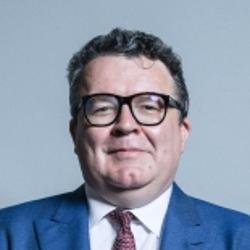
Lord Watson of Wyre Forest
Labour - West Bromwich East
Joined House of Lords: 21st November 2022
Tom Watson was elected as an MP between 2001 and 2019. He served as Shadow Secretary of State for Digital, Culture, Media and Sport between 2017 and 2019
9 APPG Memberships
Republic of Korea, Classics, Digital Inclusion, Future of Work, Kurdistan Region in Iraq, Leasehold and Commonhold Reform, Modern Conflict, Music, Prostate Cancer12 Former APPG Officer Positions
BBC, Bladder and Bowel Continence Care, Children's Media and the Arts, Complex Needs and Dual Diagnosis, Drones, Flags and Heraldry, Grid Networks, Human Gut Microbiome, Mindfulness, Morocco, Northern Culture, St George's DayDivision Voting information
Lord Watson of Wyre Forest voted No - against a party majority and against the House
One of 94 Labour No votes vs 119 Labour Aye votes
Tally: Ayes - 415 Noes - 119
Lord Watson of Wyre Forest voted Aye - against a party majority and in line with the House
One of 65 Labour Aye votes vs 153 Labour No votes
Tally: Ayes - 397 Noes - 223
Lord Watson of Wyre Forest voted Aye - against a party majority and against the House
One of 4 Labour Aye votes vs 13 Labour No votes
Tally: Ayes - 64 Noes - 314
Lord Watson of Wyre Forest voted No - against a party majority and against the House
One of 21 Labour No votes vs 181 Labour Aye votes
Tally: Ayes - 436 Noes - 49
Lord Watson of Wyre Forest voted No - against a party majority and against the House
One of 12 Labour No votes vs 197 Labour Aye votes
Tally: Ayes - 498 Noes - 31
Lord Watson of Wyre Forest voted Aye - against a party majority and against the House
One of 24 Labour Aye votes vs 185 Labour No votes
Tally: Ayes - 56 Noes - 454
Lord Watson of Wyre Forest voted No - against a party majority and against the House
One of 13 Labour No votes vs 191 Labour Aye votes
Tally: Ayes - 449 Noes - 33
Lord Watson of Wyre Forest voted No - against a party majority and against the House
One of 11 Labour No votes vs 201 Labour Aye votes
Tally: Ayes - 520 Noes - 22
Lord Watson of Wyre Forest voted Aye - against a party majority and in line with the House
One of 2 Labour Aye votes vs 208 Labour No votes
Tally: Ayes - 322 Noes - 231
Lord Watson of Wyre Forest voted No - against a party majority and against the House
One of 66 Labour No votes vs 139 Labour Aye votes
Tally: Ayes - 267 Noes - 233
Lord Watson of Wyre Forest voted Aye - against a party majority and against the House
One of 1 Labour Aye votes vs 38 Labour No votes
Tally: Ayes - 5 Noes - 311
Lord Watson of Wyre Forest voted No - against a party majority and against the House
One of 20 Labour No votes vs 179 Labour Aye votes
Tally: Ayes - 197 Noes - 40
Lord Watson of Wyre Forest voted No - against a party majority and against the House
One of 23 Labour No votes vs 175 Labour Aye votes
Tally: Ayes - 189 Noes - 47
Lord Watson of Wyre Forest voted Aye - against a party majority and against the House
One of 1 Labour Aye votes vs 107 Labour No votes
Tally: Ayes - 41 Noes - 194
Lord Watson of Wyre Forest voted Aye - against a party majority and in line with the House
One of 28 Labour Aye votes vs 33 Labour No votes
Tally: Ayes - 165 Noes - 87
Lord Watson of Wyre Forest voted No - against a party majority and against the House
One of 152 Labour No votes vs 162 Labour Aye votes
Tally: Ayes - 416 Noes - 163
Lord Watson of Wyre Forest voted Aye - against a party majority and against the House
One of 111 Labour Aye votes vs 197 Labour No votes
Tally: Ayes - 196 Noes - 375
Lord Watson of Wyre Forest voted Aye - against a party majority and in line with the House
One of 18 Labour Aye votes vs 114 Labour No votes
Tally: Ayes - 289 Noes - 118
Lord Watson of Wyre Forest voted Aye - against a party majority and in line with the House
One of 7 Labour Aye votes vs 110 Labour No votes
Tally: Ayes - 242 Noes - 116
All Debates
Speeches made during Parliamentary debates are recorded in Hansard. For ease of browsing we have grouped debates into individual, departmental and legislative categories.
Sparring Partners
(50 debate interactions)
(30 debate interactions)
(28 debate interactions)
Department Debates
(112 debate contributions)
(48 debate contributions)
(44 debate contributions)
(26 debate contributions)
Legislation Debates
(5,946 words contributed)
(4,050 words contributed)
(2,283 words contributed)
(1,288 words contributed)
Lords initiatives
These initiatives were driven by Lord Watson of Wyre Forest, and are more likely to reflect personal policy preferences.
Lord Watson of Wyre Forest has not introduced any legislation before Parliament
2 Bills co-sponsored by Lord Watson of Wyre Forest
Gambling (Industry Levy Review and Protections for Vulnerable People) Bill 2017-19
Sponsor - Richard Graham (Con)
Representation of the People (Young People's Enfranchisement and Education) Bill 2017-19
Sponsor - Jim McMahon (LAB)
Latest 50 Written Questions
(View all written questions)23 Other Department Questions
The Commission has concluded its investigation announced on 20 November 2017, into Vote Leave and other campaigners. The Commission has written to those being investigated to advise them of the initial findings. In accordance with statute they have 28 days to make further representations before final decisions are taken. The Commission will then announce the outcome of the investigation and publish an investigation report.
Minister for Women and Equalities
The Parliamentary Estate provides users with a number of different broadband solutions with varying bandwidth based on usage and capacity requirements. These are listed below:
- Parliament’s main secure private network (PN) resilient internet connection = 2Gbps bandwidth
- The secure ‘internet direct’ resilient wireless service = 400Mbps bandwidth
- Broadband over a phone line = 5–7Mbps bandwidth
The Digital Service takes action where possible to improve the broadband download speed across the Parliamentary Estate. However, due to the age and condition of the Palace of Westminster it is difficult to improve both the wiring that is available and to supplement the wireless connectivity.
The average download speeds on these services will vary as it depends on a number of factors such as the capability of the user’s device, the connection type (wired/wireless), the size of download, the current bandwidth utilisation on any given day and the volume of users/devices connected, as these internet services and bandwidths are shared with all users across the Parliamentary estate. Due to these factors, the Digital Service does not hold data relating to the average download speed.
The £5m funding is available for projects across England to celebrate the centenary of the 1918 Representation of the People Act, educate young people about democracy and encourage women to get involved in politics at all levels.
The Government Equalities Office is in the process of agreeing how the Centenary Fund will be allocated. Given the limited time available and the size of the fund, a full public consultation was not feasible. Instead, we chose to consult widely with women’s organisations and non-governmental organisations on how the Government could support projects next year.
As announced in April this year, the first statue of Millicent Fawcett, a leader of the suffrage movement, was erected in Parliament Square and funded from the £5 million Centenary Fund. Government has contributed just over £706,000 towards the statue’s costs.
We are setting up a £1.5million Women’s Suffrage Centenary Grant Scheme specifically to support local and community groups across the regions of England to celebrate the centenary. This grant scheme has two funding streams: the small grants stream has a ceiling of £2,000 to support small local celebratory events. The larger grant stream will cover projects from £2,000 to £125,000 that will principally focus on increasing young people’s understanding and engagement with democracy as well as encouraging women to participate in public life. There will be a grant administrator to oversee the scheme which will be opening soon. I have written to all members of the House to alert them to our plans and will be writing again when the scheme opens.
We are also developing plans for supporting the reach, impact and legacy of existing centenary activities in a number of cities across England that have a strong suffrage history.
The Barnett formula has been applied to this funding in the usual way and it is for the devolved administrations to decide how they choose to mark the centenary.
The £5m funding is available for projects across England to celebrate the centenary of the 1918 Representation of the People Act, educate young people about democracy and encourage women to get involved in politics at all levels.
The Government Equalities Office is in the process of agreeing how the Centenary Fund will be allocated. Given the limited time available and the size of the fund, a full public consultation was not feasible. Instead, we chose to consult widely with women’s organisations and non-governmental organisations on how the Government could support projects next year.
As announced in April this year, the first statue of Millicent Fawcett, a leader of the suffrage movement, was erected in Parliament Square and funded from the £5 million Centenary Fund. Government has contributed just over £706,000 towards the statue’s costs.
We are setting up a £1.5million Women’s Suffrage Centenary Grant Scheme specifically to support local and community groups across the regions of England to celebrate the centenary. This grant scheme has two funding streams: the small grants stream has a ceiling of £2,000 to support small local celebratory events. The larger grant stream will cover projects from £2,000 to £125,000 that will principally focus on increasing young people’s understanding and engagement with democracy as well as encouraging women to participate in public life. There will be a grant administrator to oversee the scheme which will be opening soon. I have written to all members of the House to alert them to our plans and will be writing again when the scheme opens.
We are also developing plans for supporting the reach, impact and legacy of existing centenary activities in a number of cities across England that have a strong suffrage history.
The Barnett formula has been applied to this funding in the usual way and it is for the devolved administrations to decide how they choose to mark the centenary.
The £5m funding is available for projects across England to celebrate the centenary of the 1918 Representation of the People Act, educate young people about democracy and encourage women to get involved in politics at all levels.
The Government Equalities Office is in the process of agreeing how the Centenary Fund will be allocated. Given the limited time available and the size of the fund, a full public consultation was not feasible. Instead, we chose to consult widely with women’s organisations and non-governmental organisations on how the Government could support projects next year.
As announced in April this year, the first statue of Millicent Fawcett, a leader of the suffrage movement, was erected in Parliament Square and funded from the £5 million Centenary Fund. Government has contributed just over £706,000 towards the statue’s costs.
We are setting up a £1.5million Women’s Suffrage Centenary Grant Scheme specifically to support local and community groups across the regions of England to celebrate the centenary. This grant scheme has two funding streams: the small grants stream has a ceiling of £2,000 to support small local celebratory events. The larger grant stream will cover projects from £2,000 to £125,000 that will principally focus on increasing young people’s understanding and engagement with democracy as well as encouraging women to participate in public life. There will be a grant administrator to oversee the scheme which will be opening soon. I have written to all members of the House to alert them to our plans and will be writing again when the scheme opens.
We are also developing plans for supporting the reach, impact and legacy of existing centenary activities in a number of cities across England that have a strong suffrage history.
The Barnett formula has been applied to this funding in the usual way and it is for the devolved administrations to decide how they choose to mark the centenary.
The £5m funding is available for projects across England to celebrate the centenary of the 1918 Representation of the People Act, educate young people about democracy and encourage women to get involved in politics at all levels.
The Government Equalities Office is in the process of agreeing how the Centenary Fund will be allocated. Given the limited time available and the size of the fund, a full public consultation was not feasible. Instead, we chose to consult widely with women’s organisations and non-governmental organisations on how the Government could support projects next year.
As announced in April this year, the first statue of Millicent Fawcett, a leader of the suffrage movement, was erected in Parliament Square and funded from the £5 million Centenary Fund. Government has contributed just over £706,000 towards the statue’s costs.
We are setting up a £1.5million Women’s Suffrage Centenary Grant Scheme specifically to support local and community groups across the regions of England to celebrate the centenary. This grant scheme has two funding streams: the small grants stream has a ceiling of £2,000 to support small local celebratory events. The larger grant stream will cover projects from £2,000 to £125,000 that will principally focus on increasing young people’s understanding and engagement with democracy as well as encouraging women to participate in public life. There will be a grant administrator to oversee the scheme which will be opening soon. I have written to all members of the House to alert them to our plans and will be writing again when the scheme opens.
We are also developing plans for supporting the reach, impact and legacy of existing centenary activities in a number of cities across England that have a strong suffrage history.
The Barnett formula has been applied to this funding in the usual way and it is for the devolved administrations to decide how they choose to mark the centenary.
As I said during my oral statement on Syria: Refugees and Counter-Terrorism on 7 September 2015, Official Report, column 23, these individuals presented a clear and present danger to the country and this action was taken because there was no alternative. The Attorney General was consulted and was clear there was a legal basis for this action in international law. Our Permanent Representative has informed the President of the United Nations Security Council of this activity, which was conducted in the self-defence of the UK.
As I said during my oral statement on Syria: Refugees and Counter-Terrorism on 7 September 2015, Official Report, column 23, these individuals presented a clear and present danger to the country and this action was taken because there was no alternative. The Attorney General was consulted and was clear there was a legal basis for this action in international law. Our Permanent Representative has informed the President of the United Nations Security Council of this activity, which was conducted in the self-defence of the UK.
As I said during my oral statement on Syria: Refugees and Counter-Terrorism on 7 September 2015, Official Report, column 23, these individuals presented a clear and present danger to the country and this action was taken because there was no alternative. The Attorney General was consulted and was clear there was a legal basis for this action in international law. Our Permanent Representative has informed the President of the United Nations Security Council of this activity, which was conducted in the self-defence of the UK.
I refer the hon. Member to my oral statement on Syria: Refugees and Counter-Terrorism on 7 September 2015, Official Report, column 23.
Details of my meetings with external organisations are published on a quarterly basis and are available via the gov.uk website.
Civil servants, including special advisers, may use a taxi or Government car in properly defined circumstances. Information about the use of taxis and government cars for the most senior civil servants are published on a quarterly basis at www.gov.uk.
Details of official hospitality at Chequers is published on a quarterly basis and is available via the gov.uk website.
The majority of my time is spent in Downing Street and I regularly spend time in Chequers and my constituency.
Details of meetings with external organisations, including meetings with newspaper and other media proprietors, editors and senior executives, are published on a quarterly basis and can be accessed via the gov.uk website.
Table 1 shows the number of learners aged 24+ participating in further education courses at Level 3 or above from 2010/11 to 2013/14.
Table 1: FE and Skills participation at Level 3+ and ages 24+, 2010/11 to 2013/14
2010/11 | 2011/12 | 2012/13 | 2013/14 | |
Male | 136,200 | 128,000 | 139,300 | 100,900 |
Female | 238,600 | 247,600 | 285,100 | 207,700 |
Total Learners (24+) | 374,900 | 375,600 | 424,400 | 308,600 |
Notes:
1) The source is the Individualised Learner Record.
2) This tables includes Apprenticeships, Workplace Learning, Community Learning and Education and Training provision (including the Offenders’ Learning and Skills Service) taken at General Further Education Colleges (including Tertiary), Sixth Form Colleges, Special Colleges (Agricultural and Horticultural Colleges and Art and Design Colleges), Specialist Colleges and External Institutions.
3) Volumes are rounded to the nearest hundred.
4) Age and gender are based upon self-declaration by the learner.
I refer the hon. Member to the Written Statement I made on 11 June 2015, Official Report, column 42WS.
The Department has identified and recovered the whole of two duplicate supplier payments totalling £1,000 in this period.
The Department does not maintain a central register but an analysis of the Departmental financial system and records identified that since 2010, the following duplicate payments were made and recoveries undertaken:
10/11 nil
11/12 nil
12/13 £726 of which all was recovered
13/14 £1835.40 of which all was recovered
I refer the hon. Member to the answer given today by the Minister of State for the Armed Forces, the right hon. Member for Rayleigh and Wickford, to PQ 198710.
The policy responsibility for the operation of the Official Secrets Acts is a matter for the Cabinet Office.
The Attorney General’s role in respect of the Official Secrets Act is confined to granting consent to prosecute as defined in that Act.
The Attorney General’s role in respect of the Official Secrets Act is confined to granting consent to prosecute as defined in that Act.
The Treasury Solicitor’s Department (TSol) does not hold a register of duplicate payments. Appropriate controls are in place to prevent duplicate payments and if any are identified, action is taken to recover overpaid monies. As at 18 July 2014, there are no known unrecovered duplicate payments.
Identification of the value of duplicate payments made by TSol, the Attorney General’s Office and HM Crown Prosecution Service Inspectorate since 2010 would require detailed analysis of accounting and other records which would incur disproportionate cost. However, in the 3 months since April 2014, TSol have identified and recovered duplicate payments with a total value of £13,068 representing 0.05% of the value of payments made during this period.
Available records show that, since April 2010, the Serious Fraud Office has identified and recovered £46,000 in duplicate supplier payments. No other duplicate payments have been identified.
The following table shows the value of duplicate payments identified by the Crown Prosecution Service (CPS) since 2009/10 and the proportion of such payments recovered in each of the last two financial years is presented below.
Duplicate Payments and Recoveries 2009-2014 | |||||
2009/10 | 2010/11 | 2011/12 | 2012/13 | 2013/14 | |
Duplicate payments | £135,958 | £256,803 | £72,729 | £91,578 | £149,124 |
Recovered proportion |
|
|
| 96.2% | 98.8% |
Searches of records at the Attorney General's Office have been conducted to try and determine what, if any, correspondence or files were passed to this Office in relation to these issues. We have so far found no trace of any material.
Searches of records at the Attorney General's Office have been conducted to try and determine what, if any, correspondence or files were passed to this Office in relation to these issues. We have so far found no trace of any material.
The Cabinet Office has published details of special adviser appointments annually on gov.uk since 2010 and these are available at: https://www.gov.uk/government/collections/special-adviser-data-releases-numbers-and-costs on GOV.UK.
Details of special adviser appointments between 2002 and 2010 were periodically released in Written Parliamentary Statements and are available via Hansard but records from this period are not readily available.
Captain of the King's Bodyguard of the Yeomen of the Guard (HM Household) (Deputy Chief Whip, House of Lords)
The Cabinet Office has published details of special adviser appointments annually on gov.uk since 2010 and these are available at: https://www.gov.uk/government/collections/special-adviser-data-releases-numbers-and-costs on GOV.UK.
Details of special adviser appointments between 2002 and 2010 were periodically released in Written Parliamentary Statements and are available via Hansard but records from this period are not readily available.
Captain of the King's Bodyguard of the Yeomen of the Guard (HM Household) (Deputy Chief Whip, House of Lords)
The Cabinet Office has published details of special adviser appointments annually on gov.uk since 2010 and these are available at: https://www.gov.uk/government/collections/special-adviser-data-releases-numbers-and-costs on GOV.UK.
Details of special adviser appointments between 2002 and 2010 were periodically released in Written Parliamentary Statements and are available via Hansard but records from this period are not readily available.
Captain of the King's Bodyguard of the Yeomen of the Guard (HM Household) (Deputy Chief Whip, House of Lords)
The Cabinet Office has published details of special adviser appointments annually on gov.uk since 2010 and these are available at: https://www.gov.uk/government/collections/special-adviser-data-releases-numbers-and-costs on GOV.UK.
Details of special adviser appointments between 2002 and 2010 were periodically released in Written Parliamentary Statements and are available via Hansard but records from this period are not readily available.
Captain of the King's Bodyguard of the Yeomen of the Guard (HM Household) (Deputy Chief Whip, House of Lords)
The Cabinet Office has published details of special adviser appointments annually on gov.uk since 2010 and these are available at: https://www.gov.uk/government/collections/special-adviser-data-releases-numbers-and-costs on GOV.UK.
Details of special adviser appointments between 2002 and 2010 were periodically released in Written Parliamentary Statements and are available via Hansard but records from this period are not readily available.
Captain of the King's Bodyguard of the Yeomen of the Guard (HM Household) (Deputy Chief Whip, House of Lords)
The No10 Data Science Team has a remit to improve the way in which key decisions are informed by data, analysis, and evidence using cutting-edge data science techniques. This enables the Government to use the best available evidence, throughout the policy and decision-making process, to drive long-term systems change and enable staff to collectively solve the most pressing policy challenges. They also use data to track delivery of government priority programs, working closely with Delivery Unit. The Government would not normally comment on the details of policy development and formation nor the process by which collective decisions are made across government.
The team also runs a transformation program including: (1) project rAPId, a free, open source, lightweight data sharing system; (2) the No10 Innovation Fellowships, bringing industry expertise in AI into central government on year-long secondments to improve public services; (3) Evidence House, a program to upskill civil servants in data science, AI and software engineering; and crowdsource technical solutions to complex problems; and (4) creating and managing the new Incubator for Artificial Intelligence, a 30-strong team of AI experts who are working on rapid delivery of AI projects in line with the Prime Minister’s priorities.
Shadow Minister (Treasury)
I am informed that the noble Lord has been sent responses from the lead departments, (1) by the Ministry of Defence and (2) by the Department for Business and Trade.
Shadow Minister (Treasury)
The Cabinet Office intends to publish guidance on the use of non-corporate communications channels as soon as possible. This will replace the guidance published in 2013.
Shadow Minister (Treasury)
The Cabinet Office intends to publish guidance on the use of non-corporate communications channels as soon as possible. This will replace the guidance published in 2013.
Shadow Minister (Treasury)
Central Government contracts above £10,000 are published on Contracts Finder, including the awarded value of the contract. (https://www.contractsfinder.service.gov.uk)
Central Government contracts above £10,000 are published on Contracts Finder, including the awarded value of the contract. (https://www.contractsfinder.service.gov.uk)
Central Government contracts above £10,000 are published on Contracts Finder, including the awarded value of the contract. (https://www.contractsfinder.service.gov.uk)
The policy of Government is as set out in Paragraph 21 ‘Official information: standards of conduct and procedures’ and states, "The police are entirely operationally independent of Government and have the right and duty to investigate criminal activity wherever it occurs. No part of Government is above the law. In respect of unauthorised disclosure of official information under, for example, the Official Secrets Act, if the police find evidence of a suspected breach of the criminal law, it is entirely within the powers of the police to begin an investigation under their own auspices, whether or not the Government has raised the incident with them."
A copy is in the Library of the House and is available at https://assets.publishing.service.gov.uk/government/uploads/system/uploads/attachment_data/file/228774/7863.pdf
There are no plans to establish a Public Inquiry on the conduct of the EU referendum. The EU referendum was carried out based on legislation passed by Parliament and almost three quarters of the electorate took part. The EU referendum provisions were carefully scrutinised and ratified by Parliament. In line with the precedent for referendums, there was a six week period in which the formal result and administration of the EU Referendum could be challenged by judicial review. We treat the integrity and security of our democratic processes extremely seriously.
If offences are alleged, it is right that they are investigated thoroughly by the appropriate agencies. That is what is happening at the moment and those agencies and investigations are independent of government.
The information requested falls within the responsibility of the UK Statistics Authority. I have asked the Authority to reply.
The Government has said previously that we have not seen evidence of successful foreign
interference in UK elections and we take any allegations of interference in UK democratic
processes by a foreign government extremely seriously. That remains the case. We know
that certain states routinely use disinformation and other means as a foreign policy tool,
and have seen evidence of this happening elsewhere. It should therefore not surprise us
that they might try to influence democratic processes in the UK.
The Government has said previously that we have not seen evidence of successful foreign
interference in UK elections and we take any allegations of interference in UK democratic
processes by a foreign government extremely seriously. That remains the case. We know
that certain states routinely use disinformation and other means as a foreign policy tool,
and have seen evidence of this happening elsewhere. It should therefore not surprise us
that they might try to influence democratic processes in the UK.
The Government has not received an advance copy of the report, and therefore cannot speak to who is named in it.
The Electoral Commission is accountable to Parliament, via the Speaker’s Committee, and does not report directly to Ministers.
In that context, the Government has not received advance copy of such a report, and would not normally expect to receive advance reports on its casework decisions.
The National Security Capability Review (NSCR) identifies areas where we can do further cross-government work, including as one example on our strategic communications. The NSCR will set out further details when published.
The National Security Capability Review (NSCR) identifies areas where we can do further cross-government work, including as one example on our strategic communications. The NSCR will set out further details when published.