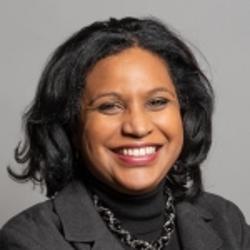
Janet Daby
Labour - Lewisham East
18,073 (44.5%) majority - 2024 General ElectionFirst elected: 14th June 2018
1 APPG Officer Position (as of 12 Oct 2026)
Sickle Cell and Thalassaemia1 APPG Membership
Women affected by the Criminal Justice System10 Former APPG Officer Positions
Children in Police Custody, Christianity in the Holy Land, Dyslexia and Other Specific Learning Difficulties, Food Banks, Magnitsky Sanctions, Parkrun, Philanthropy and Social Investment, Safeguarding in Faith Communities, Stem Cell Transplantation and Advanced Cellular Therapies, TamilsDivision Voting information
Debates during the 2024 Parliament
Speeches made during Parliamentary debates are recorded in Hansard. For ease of browsing we have grouped debates into individual, departmental and legislative categories.
Sparring Partners
Shadow Minister (Policy Renewal and Development)
(54 debate interactions)
Shadow Secretary of State for Health and Social Care
(17 debate interactions)
(11 debate interactions)
Department Debates
(282 debate contributions)
(18 debate contributions)
(10 debate contributions)
(10 debate contributions)
Legislation Debates
(16,550 words contributed)
(1,876 words contributed)
(929 words contributed)
(765 words contributed)
Lewisham East Petitions
e-Petitions are administered by Parliament and allow members of the public to express support for a particular issue.
If an e-petition reaches 10,000 signatures the Government will issue a written response.
If an e-petition reaches 100,000 signatures the petition becomes eligible for a Parliamentary debate (usually Monday 4.30pm in Westminster Hall).
of 78,056 signatures (0.30%)
of 52,995 signatures (0.21%)
of 132,469 signatures (0.20%)
of 72,645 signatures (0.17%)
of 120,145 signatures (0.09%)
of 132,469 signatures (0.20%)
of 78,056 signatures (0.30%)
of 72,645 signatures (0.17%)
of 52,995 signatures (0.21%)
of 120,145 signatures (0.09%)
Latest EDMs signed by Janet Daby
Imprisonment for Public Protection sentences: Justice Committee report
Tabled by: Kim Johnson (Labour - Liverpool Riverside)That this House welcomes the Justice Committee's report on Imprisonment for Public Protection (IPP) sentences, which were introduced under the Criminal Justice Act 2003 to detain people in prison who posed a significant risk of causing harm to the public; notes that IPP sentences were abolished prospectively, but not retrospectively, …
(Most recent: 27 Apr 2023)
Signatures by party:
Labour: 27
Plaid Cymru: 3
Your Party: 1
Democratic Unionist Party: 1
Independent: 1
Liberal Democrat: 1
The service of Oliver Denton Lieberman
Tabled by: Tulip Siddiq (Labour - Hampstead and Highgate)That this House recognises Oliver Denton Lieberman’s dedication and public service as an office manager during many turbulent years in politics; appreciates that he has coordinated the campaign within Parliament to free Nazanin Zaghari-Ratcliffe and supported her family; acknowledges the role he has played in running an efficient office and …
(Most recent: 29 Oct 2021)
Signatures by party:
Labour: 14
Independent: 1
Your Party: 1
Scottish National Party: 1
Commons initiatives
These initiatives were driven by Janet Daby, and are more likely to reflect personal policy preferences.
MPs who are act as Ministers or Shadow Ministers are generally restricted from performing Commons initiatives other than Urgent Questions.
Janet Daby has not been granted any Urgent Questions
1 Adjournment Debate led by Janet Daby
Janet Daby has not introduced any legislation before Parliament
5 Bills co-sponsored by Janet Daby
National Eye Health Strategy Bill 2022-23
Sponsor - Marsha De Cordova (Lab)
Criminal Appeal (Amendment) Bill 2022-23
Sponsor - Barry Sheerman (LAB)
Child Criminal Exploitation Bill 2021-22
Sponsor - Baroness Brown of Silvertown (Lab)
Clean Air (No. 3) Bill 2017-19
Sponsor - Geraint Davies (Ind)
Latest 8 Written Questions
(View all written questions)New digital Individual Support Plans will set out the educational needs of children and young people with SEN and the support required to help them thrive, bringing information together in one place to support students and their families to experience smoother, better-informed transitions. We are also introducing new expectations for planning for post-16 destinations to begin at least 12 months before students leave school.
Minister of State (Education)
Israeli settlements are illegal under international law, undermine the two-state solution, and contribute to instability and violence. We completely oppose the advertising of property or auctioning of land in those settlements, and we have updated advice to UK businesses to make clear that they should not engage in economic activity in illegal settlements, and warn them of the reputational and potentially legal consequences if they do so.
Minister of State (Cabinet Office) (Jointly with the Foreign, Commonwealth and Development Office)
In both Lebanon and Palestine, we ensure that our humanitarian and recovery efforts recognise and address the specific needs of women and girls. For instance, in Palestine, our funding to the Occupied Palestinian Territory Humanitarian Fund and the United Nations Population Fund has supported women led organisations to deliver specialised interventions to support survivors of gender-based violence in Gaza. The UK will continue to advocate for the full, equal, meaningful and safe participation of women in political and peace processes in the region.
Minister of State (Cabinet Office) (Jointly with the Foreign, Commonwealth and Development Office)
In both Lebanon and Palestine, we ensure that our humanitarian and recovery efforts recognise and address the specific needs of women and girls. For instance, in Palestine, our funding to the Occupied Palestinian Territory Humanitarian Fund and the United Nations Population Fund has supported women led organisations to deliver specialised interventions to support survivors of gender-based violence in Gaza. The UK will continue to advocate for the full, equal, meaningful and safe participation of women in political and peace processes in the region.
Minister of State (Cabinet Office) (Jointly with the Foreign, Commonwealth and Development Office)
1 Ministry of Housing, Communities and Local Government Questions
(View all Janet Daby's MHCLG questions)We recognise the difficulties facing some leaseholders in buildings under 11 metres who are being asked to pay significant cladding remediation costs. The Department’s investigations indicate that most buildings under 11 metres are safe and do not require cladding remediation, with risks often able to be addressed through lower-cost mitigations. However, as set out in the Remediation Acceleration Plan update, we remain committed to providing funding in specific circumstances where cladding remediation is needed to address life-critical fire safety risks from cladding. We intend to provide an update on this shortly.
The Ministry of Justice has not undertaken a specific assessment of the adequacy of legal advice provided to asylum claimants and foreign national offenders in immigration cases.
Reported cases in which immigration advice may have fallen below expected standards are concerning and underline the important role of the relevant regulators in maintaining standards and investigating misconduct. Under the Immigration and Asylum Act 1999, immigration advisers must be registered with the Immigration Advice Authority (IAA) or authorised through a Designated Qualifying Regulator (DQR) in England and Wales, or a Designated Professional Body (DPB) in Scotland or Northern Ireland. The IAA, DQRs and DPBs are responsible for ensuring advisers are fit, competent and meet appropriate professional standards.
For advisers and organisations it regulates directly, the IAA assesses fitness and competence as part of registration, requires organisations to renew their registration annually, conducts audits, and can investigate complaints and take regulatory or enforcement action where appropriate.
The Solicitors Regulation Authority (SRA) exercises The Law Society of England and Wales' functions as a DQR for solicitors and undertook thematic reviews of immigration and asylum legal services in 2022 (https://www.sra.org.uk/immigration-thematic/) and 2024 (https://www.sra.org.uk/sra/research-publications/thematic-review-asylum-legal-services/). These reviews found generally good standards of service while identifying areas for improvement. The SRA has also published guidance on solicitors' obligations when providing immigration advice, available here: https://www.sra.org.uk/solicitors/guidance/immigration-work-guidance/.
In addition, the Legal Aid Agency monitors providers of legal aid funded immigration and asylum advice through independent peer reviews, which assess the quality of legal work, and contract compliance audits.
Minister of State (Ministry of Justice)
The Ministry of Justice publishes data on pre court remands at criminal courts in England and Wales in the Remands data tool, that can be downloaded from the Criminal Justice Statistics landing page here: Criminal Justice Statistics.
However, data held centrally does not include details on the circumstances around the release of a defendant held on remand.
This information may be held in court records but to examine individual court records would incur disproportionate costs.
Parliamentary Under-Secretary (Ministry of Justice)
The Ministry of Justice publishes data on pre-court remands at criminal courts in England and Wales in the Remand data tool, that can be downloaded from the Criminal Justice Statistics landing page here: Criminal justice statistics - GOV.UK.
However, data held centrally does not include details on the circumstances around the release of a defendant held on remand.
The information may be held in court records but to examine individual court records would incur disproportionate costs.
Parliamentary Under-Secretary (Ministry of Justice)